Things I've built, and what was hard about them.
I lead platform engineering and SRE for India at a global financial institution. Outside that, I design, build, deploy and operate production systems end to end — this page is what came out of that, and the engineering decisions behind each one.
Custos
Live · demo needs no sign-inEnterprise ITSM where an AI proposes production changes — and something other than the AI decides whether they worked
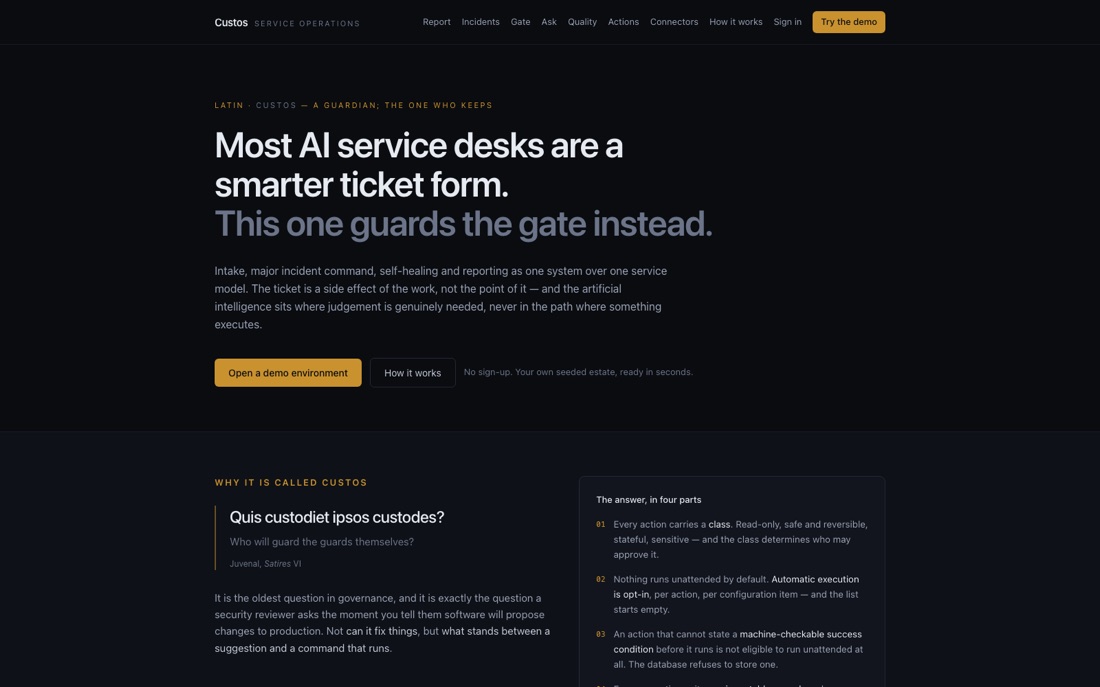
Intake, major-incident command, self-healing and reporting over one service model. The landing page asks Quis custodiet ipsos custodes? because that is literally the security reviewer’s question about an agent that touches production. Every visitor gets their own seeded tenant with a real estate to operate — a filesystem genuinely at 95%, a workload genuinely returning 503, a certificate genuinely five days from expiry.
Intake includes two conversational voice agents. The Tier 1 service desk takes an employee through laptops, Outlook, Excel, network, Wi-Fi and password lockouts against six knowledge-base articles, then either resolves on the call or raises the incident with an SLA deadline before hanging up. The major incident desk does something else entirely: capture and convene in ninety seconds, page the responders, and get off the line.
Those are two agents because they are two jobs, not because of volume. One Retell agent handles many concurrent calls perfectly well. What it cannot do is be patient and be fast in the same prompt — Tier 1 exists to slow down for a frustrated non-technical caller and fix one person’s problem, while the major incident desk exists to extract the facts and hang up. Splitting them cut the Tier 1 prompt by roughly 40%. Ticket numbers are read digit by digit, because “INC1042” spoken at conversational speed is not a number anyone can write down.
Verification is only meaningful if it can say no. So
verify() receives an observability port and nothing else — not the
job handle, not the result, not the exit code. It cannot see whether the playbook claimed
success; it can only go and look at the system. An absent reading is a failure, never a pass,
because a monitoring gap during a remediation is exactly when a silent pass does most damage.
A negative control ships in every tenant. Alongside the real remediations
there is a no-op: same class, same verification spec, a template that reports success and
changed-true while doing nothing at all. Side by side on the same CI — expand a filesystem
verifies at 61%, the no-op fails verification at 95.4%. Mutation-tested: weaken
verify() to trust the playbook’s own report and four tests go red.
EXECUTED_UNVERIFIED is a first-class outcome. Higher-risk actions may legitimately
have no automatic check, and recording those as “verified” would be the audit trail
flattering itself.
One finding worth the scar: a connector framework is an SSRF engine pointed at your
own network. It fetches customer-supplied URLs, and this box also runs nine other
production services and Postgres on loopback. The fetch layer resolves the host before
connecting, refuses private, loopback, link-local, CGNAT and metadata ranges, treats
::ffff:127.0.0.1 as loopback, and sets redirect: 'manual' —
a 302 would otherwise walk straight past the check.
Cadre
Live · console is sign-in gatedA complete HR system packaged as a module that plugs into a product you already sell
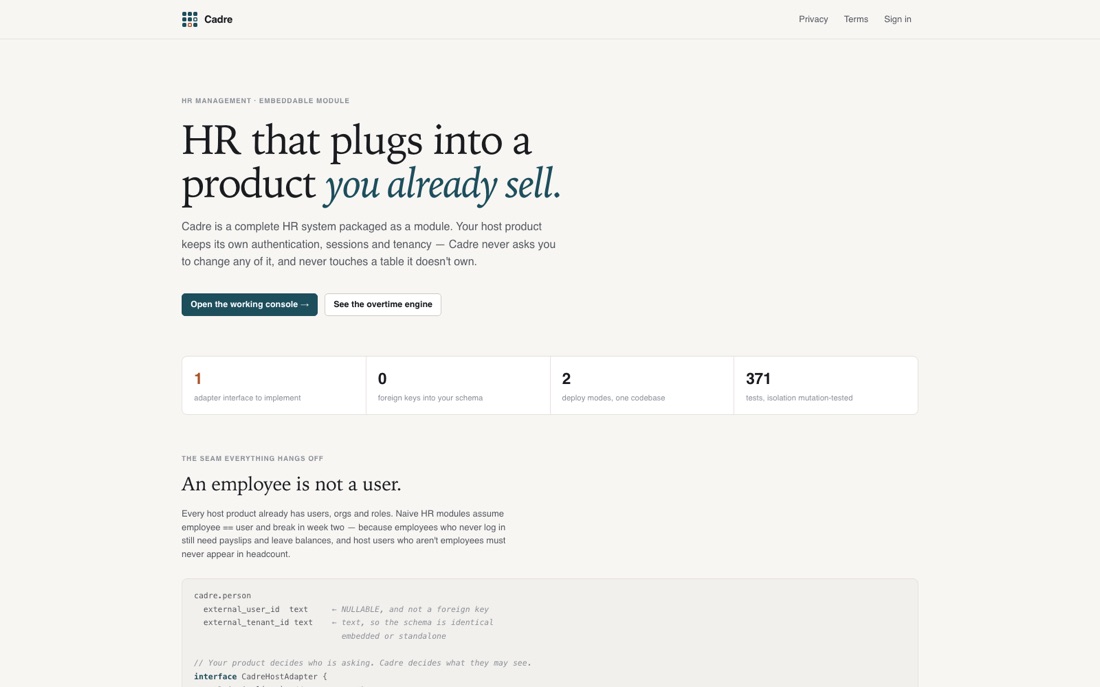
Payroll, leave, org structure and statutory packs, built to embed rather than to replace. The host product keeps its own authentication, sessions and tenancy; Cadre implements one adapter interface, adds no foreign keys into anyone else’s schema, and runs from the same codebase either embedded or standalone. 371 tests.
The seam the whole thing hangs off is that an employee is not a user. It sounds like pedantry until you try to serve two hosts: TaxPro gives a person exactly one tenant, Custos gives them many organisations with a different role in each. No shared users table satisfies both. So the link to the host is a nullable, non-foreign-key column — which is also what lets an employee who never logs in still receive a payslip, and a host user who isn’t an employee stay out of headcount.
Four decisions were cheap on day one and unfixable later, so they went in first: bitemporal dating, so a change and a correction are different events rather than the same UPDATE; positions as objects, so a seat can exist unfilled; approvals resolved by walking up the org tree; and positional security. Designation is derived from band rather than stored alongside it — store both and they drift.
The worst bug was an access-control one, and it read as a naming problem. A single column held both who holds a role and what that role covers. Grant someone HR at the root of the tree and the two meanings collapse: everybody became HR. Splitting holder from scope fixed it. Two others were found the same way — by looking, not by a test — including a schema-isolation test that passed while inspecting zero columns, caught only by asserting the walk had actually happened.
The statutory packs ship refusing to run. India’s rates are unverified placeholders, so a guard rejects every live payroll run while the verification date is null. That refusal is the feature: a payroll engine that is quietly wrong is worse than one that declines.
01 Platform engineering
CloudPro
LiveA federated multi-cloud provisioning control plane — Azure + AWS
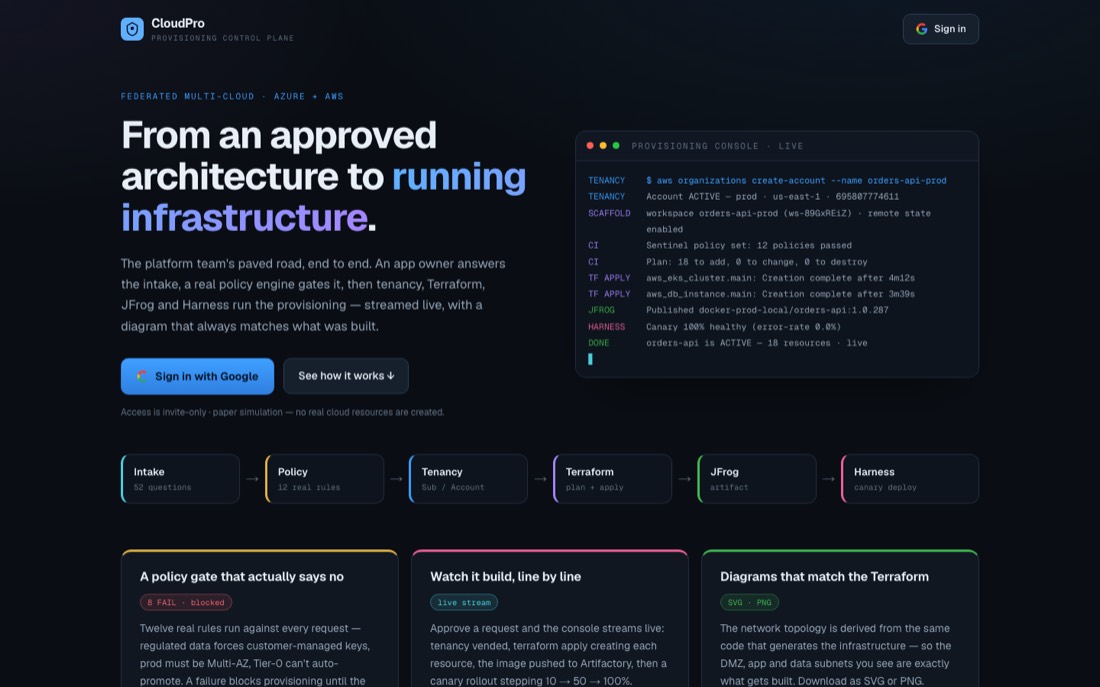
The platform team's paved road, end to end. An application owner answers a 52-question intake across 13 sections; a policy engine gates it; then tenancy vending, Terraform, JFrog and Harness run the provisioning — streamed live, stage by stage, with an architecture diagram derived from the same code that generates the infrastructure.
Ports and adapters, done so that going live is configuration rather than a code change. Every external system — cloud, Terraform Enterprise, Harness, JFrog — sits behind an interface, and a single registry picks the implementation per port from one environment variable. The orchestrator names no mock anywhere. An earlier version imported mocks directly at eight call sites, which meant "swap the adapter" was really "edit the workflow" — that was the bug worth fixing.
Resolution is lazy per port, so a bad value fails the provisioning run visibly in the console stream instead of killing the whole app at import.
The policy engine is real code, not a mock — twelve rules, and a FAIL genuinely blocks provisioning. Exactly one non-mocked decision component, chosen deliberately: it's the part where the interesting logic lives.
No LLM calls anywhere in it. Policy is rule functions, config generation is deterministic, the adapters are state machines. None of that should be probabilistic, and knowing where not to reach for a model is part of the design.
ProductPro
LiveA product & platform catalogue with stage gates computed from real data
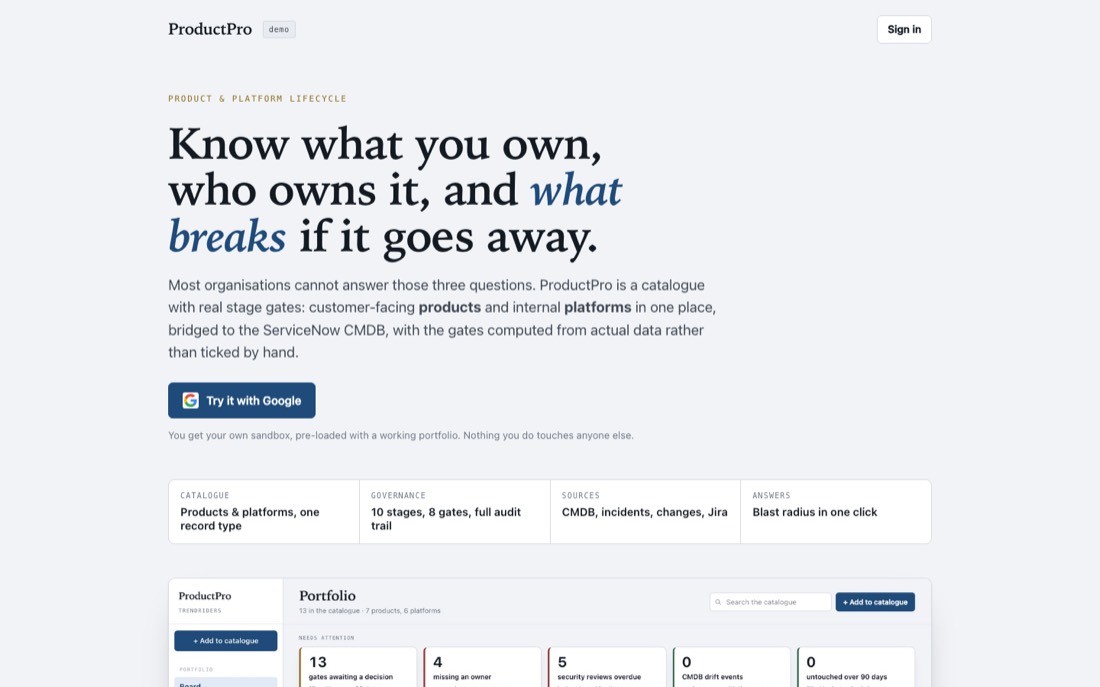
The product development lifecycle in one place: every product and platform tracked through its stages, with gates at each step that are computed — from the CMDB, incidents, changes and Jira — rather than ticked by hand. It answers the three questions most organisations cannot: what do you own, who owns it, and what breaks if it goes away.
Products and platforms are one table, not two. Splitting them is the obvious modelling choice and it makes the dependency graph impossible — a platform that supports three products has to be the same kind of node as the products, or you cannot traverse it. Related: CIs are deliberately not the spine of a product record, because a product can exist with zero infrastructure; CI linkage is a gate criterion instead.
The tenant-isolation tests were passing for the wrong reason. UUID primary keys partition the graph on their own, so a cross-tenant query returns nothing whether or not the guard exists — the tests were green and proving nothing. Mutation testing exposed it: delete the guard, re-run, and confirm the test actually goes red. The real risk turned out to be a mis-stamped tenant id on a write, which no read-side test would ever have caught.
The mock CMDB is a byte-identical fake ServiceNow, same envelopes and error shapes. Anything looser and swapping in a real instance becomes a rewrite rather than a config change — the same ports-and-adapters discipline as CloudPro.
The diagrams module reuses TinguDraw's geometry core — about 1,120 of its 4,216 lines — but not its renderer. Shapes bind to catalogue records, so a diagram is a live view of the dependency graph rather than a drawing that goes stale the day after it is made.
02 Multi-tenant SaaS
TaxPro
LiveA compliance suite for Indian chartered accountants — Income Tax, GST, TDS
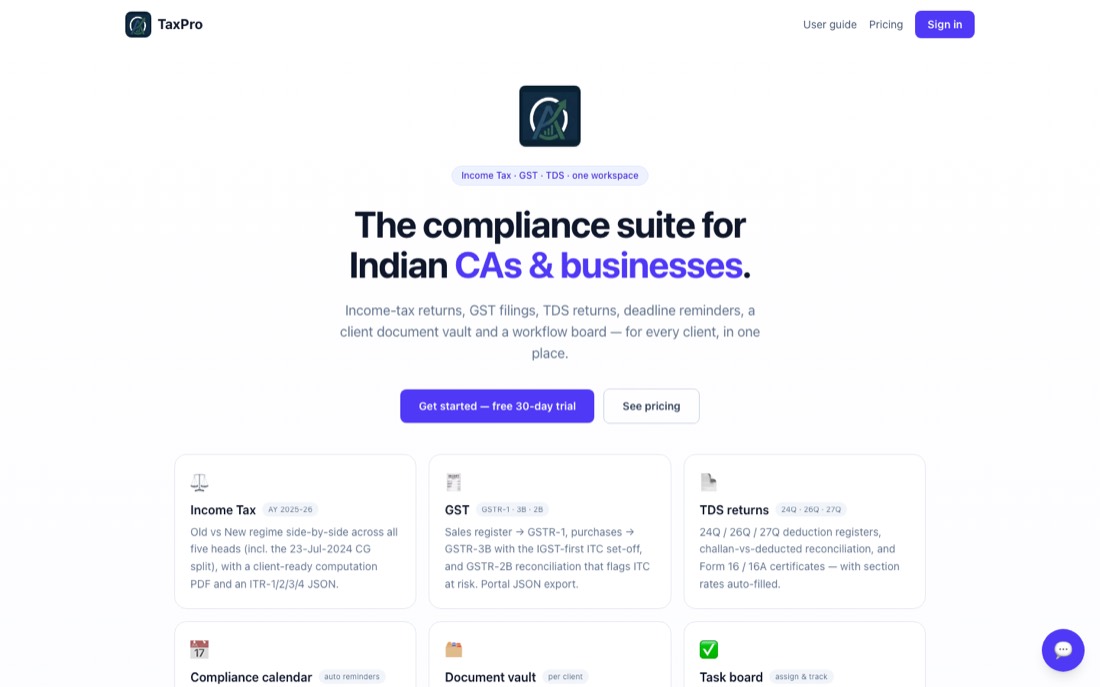
Income-tax returns with old-versus-new regime side by side, GST filings with GSTR-2B reconciliation that flags input credit at risk, TDS registers and Form 16 generation, a compliance calendar, a per-client document vault and a workflow board. Every CA firm on it is a separate tenant.
Tenant isolation is enforced by the build, not by discipline. CI gates on tests, typecheck, lint and a dedicated isolation audit — a cross-tenant read has to fail the pipeline, because "we'll remember to filter by tenant" is not a security model.
The audit itself is the part I'd want to talk about. My first harness reported nine isolation breaches. All nine were false positives — the harness was bypassing the application's own filtering, so it was testing the database rather than the product. Adding two controls, a row-count check and a random-UUID probe, disproved every one of them. The rebuilt harness found three real defects, which were fixed: 51 requests correctly refused, none returning the wrong status.
That's the lesson I take from it — a test that can't distinguish "the app is safe" from "my test is wrong" will happily report either.
Vakalat
LivePractice management for Indian advocates — cases, hearings and a client portal
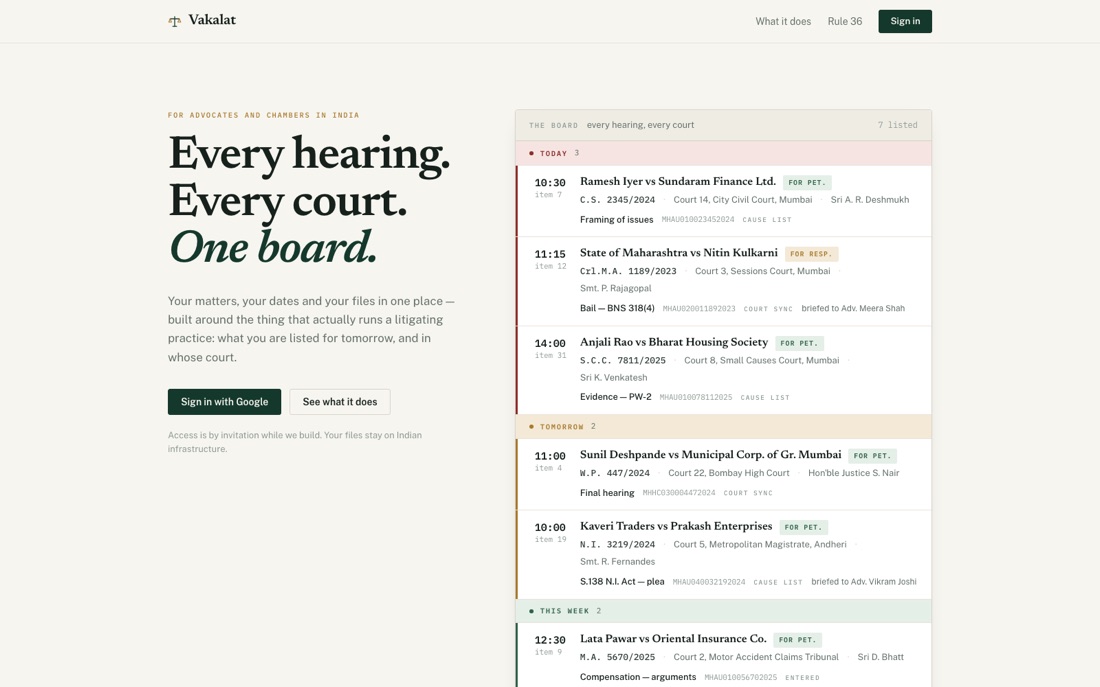
Case and hearing tracking with a client-facing portal, built for chambers rather than for firms. Multi-tenant from the first migration, with tenant isolation enforced in the database rather than in application code.
Three findings decided the product before any code was written. India’s eCourts serves a CAPTCHA on every case lookup, so a scraper is not buildable — you buy the feed. Parser maintenance against a hostile source is negative operating leverage and is what kills this kind of product two years in.
Bar Council Rule 36 bans advocate solicitation, with a 2008 proviso permitting a site carrying only the scheduled fields; a 2024 Madras High Court judgment puts the line at ratings and brokering rather than listing. So the public profile table has no free-text column — the constraint is in the schema, not in a content policy someone has to remember.
And the BNS, BNSS and BSA replaced the IPC, CrPC and Evidence Act in July 2024, which means every model’s criminal law is stale. That argues retrieval over fine-tuning, with a deterministic old-section-to-new-section mapper rather than a model guess.
On isolation: FORCE ROW LEVEL SECURITY is load-bearing, because the role that
owns the tables otherwise bypasses its own policies. Policies carry WITH CHECK as
well as USING — the real risk is a mis-stamped tenant id on a write,
not a leaky select. The tenant setting is transaction-scoped so a pooled connection cannot carry
one chamber into the next request.
WeCare
Live · proof of conceptA home & care services platform for the Australian market — and the compliance work that decided how it had to be built
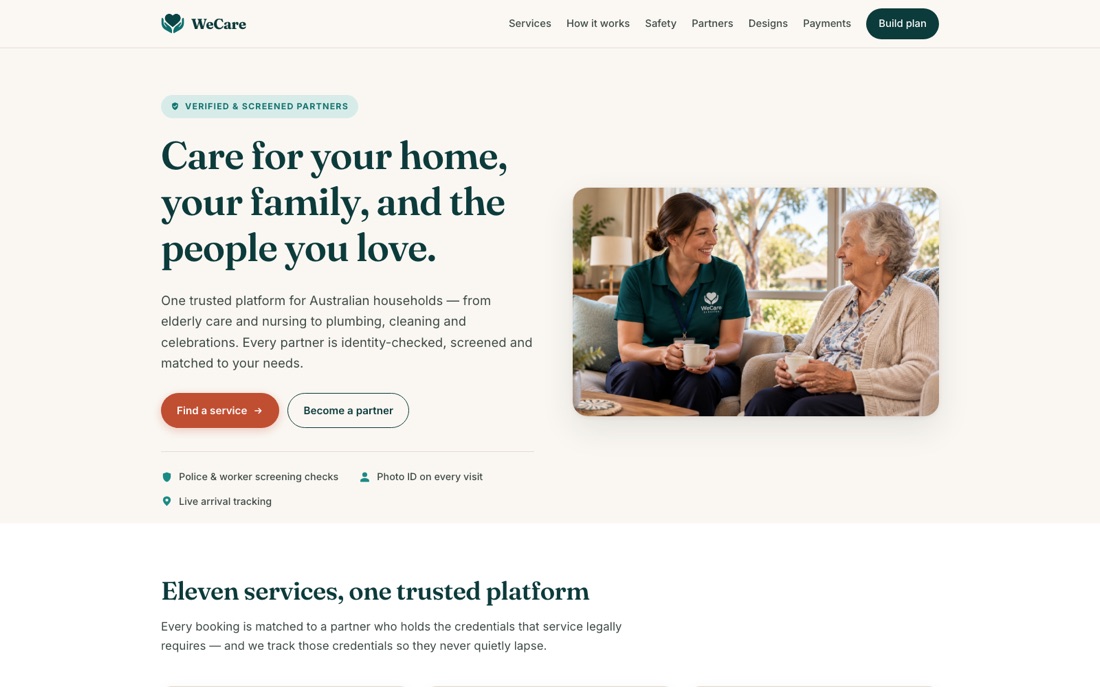
Eleven services, from elderly care and nursing through to plumbing and cleaning,
matched to partners who hold the credentials each service legally requires. Landing, build plan,
screen designs and payments model are public; a working booking app runs behind
/app.
Four regulatory findings shaped the architecture before any screen was drawn, and two of them would have been expensive to discover late.
Card surcharging becomes illegal in Australia on 1 October 2026. The processing fee cannot be passed to the customer, so it has to sit inside the commission — which means a 20% headline rate actually nets about 17.65%. Any pricing model built on a surcharge was dead before it was written.
The Privacy Act applies from day one, and the small-business exemption does not reach it. The Act’s definition of a health service expressly covers aged care, palliative and disability care — so offering elderly care puts the platform inside the Act at any turnover, with sensitive-information handling and breach notification from the first booking.
Worker screening is state-based and mostly not portable. A New South Wales working-with-children check is invalid in Victoria; Queensland recognises no interstate check at all. The NDIS worker screening check is portable. That single fact forced the design: credential requirements are data — service × state → credential — never code, because the alternative is a rule engine that needs a deploy every time a state moves.
One bug worth the scar, from the deploy itself. Next’s basePath does not
prefix a plain <a href>, so roughly 48 internal links shipped
404ing. What made it survive review is that forms kept working —
redirect() does get the prefix — so the test suite and a browser pass that
drove the flows both stayed green. Driving forms is not using the app; you have to click every
nav item as every role.
03 Data platform & research
DRISHTI / TrendRiders
LiveA multi-asset market-research platform — stocks, futures, options and commodities
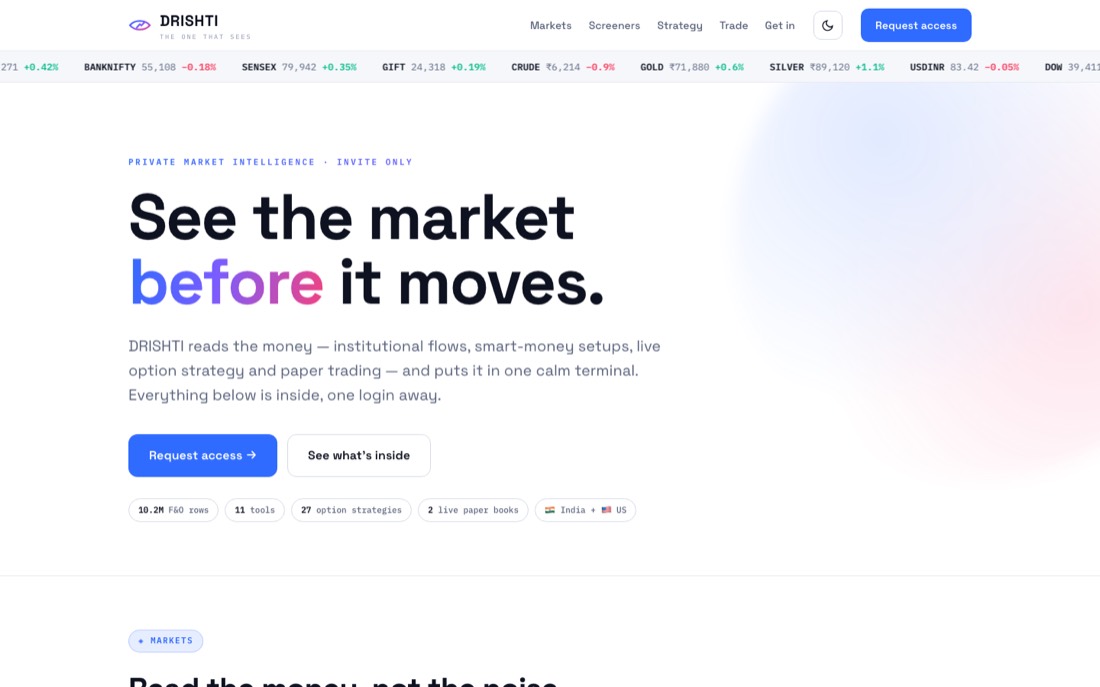
A stock screener with a custom expression language, a backtester that shares the screener's evaluation engine, options-flow analytics over the NSE derivatives bhavcopy, sector rotation, and paper-trading books for Indian and US equities. Scheduled scans deliver email alerts intraday and after the close.
It spans four asset classes — equities across roughly 750 NSE names and a US universe, index and commodity futures, options (chain analytics, a 27-strategy payoff engine, writer positioning), and commodities in gold, silver, crude and natural gas. Four independent feeds sit behind one interface — NSE India for indices, FII/DII flows and the daily bhavcopy, DhanHQ for live index and MCX data, Twelve Data for round-the-clock international commodities, and yfinance as the fallback and the US equity source — each behind a common fetcher so a dead feed degrades to a cached or alternate source instead of taking the platform down.
Screening is evaluated on wide frames rather than per symbol. The panel is dates × ~750 symbols, so a 50-day moving average is one rolling mean across the entire universe instead of 750 separate passes — a full scan lands in roughly 80 milliseconds. The same frame then powers the backtest, so a strategy is tested by exactly the code that screens it.
User expressions are parsed, not evaluated. A whitelisted AST walker with
arity and literal checks — no eval, and deliberately no LLM anywhere in the
execution path. Language models are useful for helping someone write a query; they have no
business being inside it.
Most of the work is getting the data honest. Exchange bhavcopy is unadjusted, so corporate actions are reconstructed from the exchange's own previous-close field. Two sources are spliced to reach back further, validated at r = 0.972 across 484,640 symbol-days before being trusted.
Every result is measured against a matched control, with block bootstrap over dates. That discipline is why several of my own ideas are documented as not working — which is the point of building the harness.
Lakshya
Live · no sign-inInterview preparation derived from real job postings, not from memory
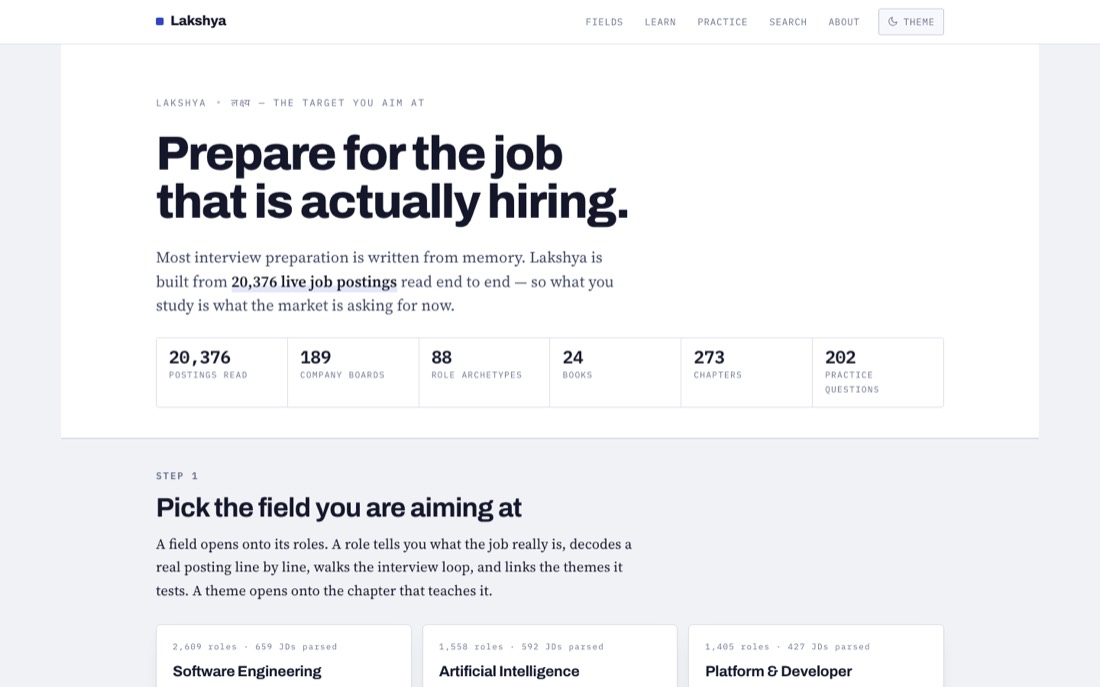
Most interview prep is written from recollection of what interviews used to ask. Lakshya is built from 20,376 live job postings read end to end across 189 company boards — 88 role archetypes, 24 books, 273 chapters and 202 practice questions, each traceable back to what employers are actually asking for now.
The job boards people scrape are mirrors. LinkedIn and Naukri aggregate from employers' own systems, so the primary source is the ATS. Workday exposes a public, unauthenticated endpoint per tenant, which is what makes the GCC market reachable at all. It also avoids the legal exposure: India's IT Act §43(b) makes scraping a riskier proposition than the post-hiQ position in the US.
A refresh once reported "0 postings moved" while 82 had. It was analysing the corpus it had just overwritten, so it compared the new data against itself. Nothing errored and the silence read as success — the most dangerous shape a bug can take.
Every published figure has to reproduce, and the population has to be held constant. A wider corpus showed roughly ten points lower on several terms, which looked like the market shifting. A like-for-like control — the same 69 companies, freshly fetched — reproduced the original numbers exactly (product sense 84% vs 84%, testing 9% vs 8%). It was a population effect, not drift. 19 of 19 figures now reproduce from source.
The finding that drove the product: the AI job market has bifurcated. Agents appear in 64% of postings, evals 59%, customer-facing work 58% — against PyTorch 11%, PhD 11% and RLHF 4%. Most preparation targets the wrong tenth. Evals are named in 59% of postings but appear in under 2% of job titles, which is precisely where the mismatch pays.
04 Native application development
PDFLab
macOS · not webAn Acrobat-class PDF editor for macOS
Page operations, native text editing, ink and drawn signatures, OCR to searchable text, cryptographic signatures with a visible signature box, and password add/remove backed by the system keychain. Swift, no Electron, 81 automated checks.
Apple's PDFKit cannot edit page text, and has no cryptographic-signature API at all. Both were built from scratch: text editing by rewriting the PDF content stream with real paragraph reflow, and signing via CMS to produce PKCS#7. The common workaround is to bundle PDFium; it turned out not to be necessary.
Three findings that cost real time and are not in the documentation:
write(to:) preserves encryption even after unlock(), so a document has
to be rebuilt page by page to genuinely decrypt; CMSEncoder emits indefinite-length
BER rather than DER; and verifying with openssl needs -binary or line-ending
canonicalisation makes a perfectly good signature look broken.
One more worth mentioning because it was pure developer experience: signing imported the certificate into the login keychain, and macOS gates key access per application — so every freshly compiled binary re-prompted for a password. Several hundred prompts before I switched to a throwaway keychain. Now 61 of 61 signing tests run unattended.
TinguDraw
Live · no sign-inA whiteboard with its own rendering engine — built for stylus input
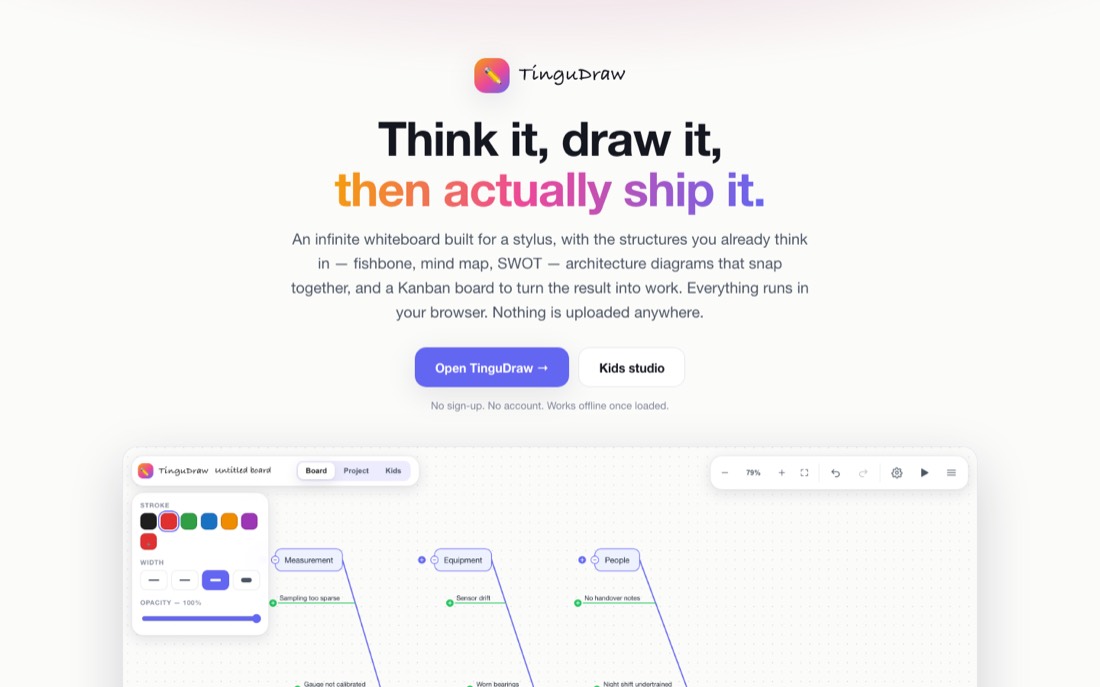
Three modes — a freeform board, a project/Kanban mode and a kids' drawing studio — plus eleven brainstorming templates. Runs entirely in the browser as a static bundle: no server process, no database, nothing to sign into.
I evaluated the obvious libraries and rejected both, for specific reasons. Excalidraw has open issues for exactly the two things that matter on an iPad — no stylus-only mode, and smoothing strong enough to feel laggy. tldraw became source-available in 2025, so it ships a watermark unless you pay for a key. Writing the engine was the cheaper option.
Stylus support on the web is thinner than it looks. Safari doesn't implement
getCoalescedEvents(), so on the browser most iPad users have you lose the
intermediate points between frames. The freehand library silently fabricates pressure values
unless explicitly told not to. And the Pencil's squeeze and double-tap gestures aren't exposed
to web pages at all.
The detail that made it feel right: ink base width has to be roughly 3–11× the shape stroke width, or pressure variation lands below one pixel and the stylus feels completely dead — technically correct, and unusable.
Tested on a real iPad with an Apple Pencil in both Safari and Chrome, which is the only test that counts here.
05 Where AI actually does the work
Samajh
LiveA voice-first AI tutor for Indian school children
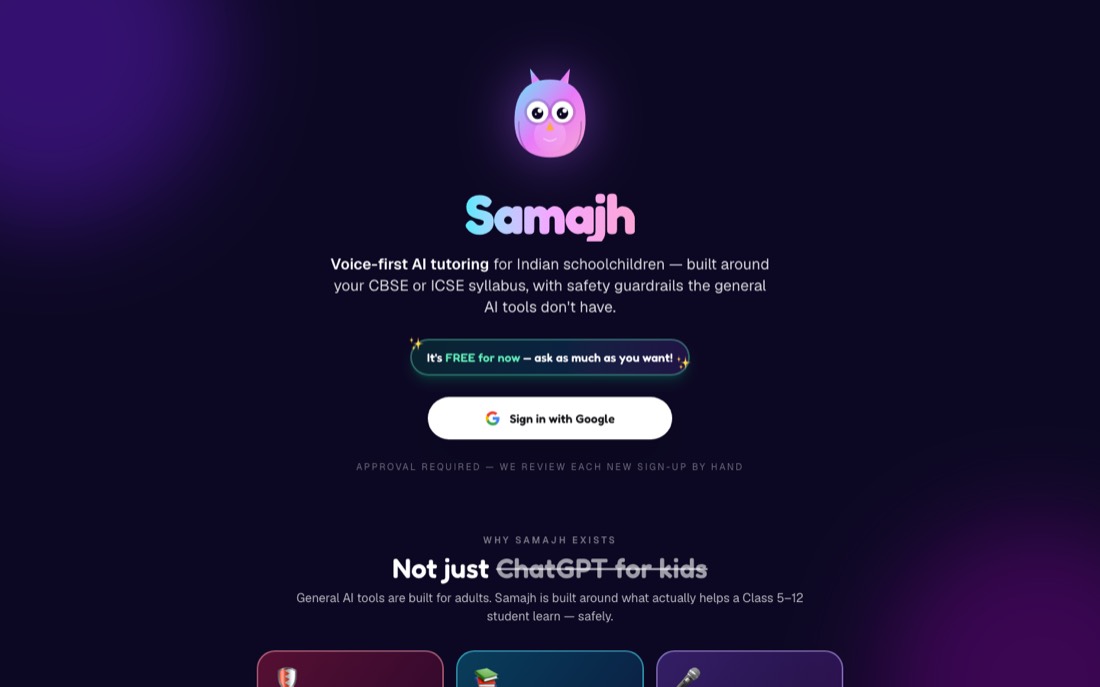
A child speaks a doubt in Maths, Science or English. Whisper transcribes it, Claude reasons through it, and ElevenLabs speaks the answer back — using everyday Indian analogies, rotis for fractions and cricket for force, broken into small steps. Covers NCERT CBSE classes 5 to 12.
A real-time voice loop has a latency budget, and three model calls in series will blow it. The interesting work is in the orchestration — streaming, overlapping the stages, and failing gracefully when one provider is slow — rather than in the prompts.
Access sits behind Google sign-in with an approval step, for the ordinary reason that unbounded API credits and children's voice data both need a gate.
Raahi
LiveAn AI travel planner for when you don't know where to go
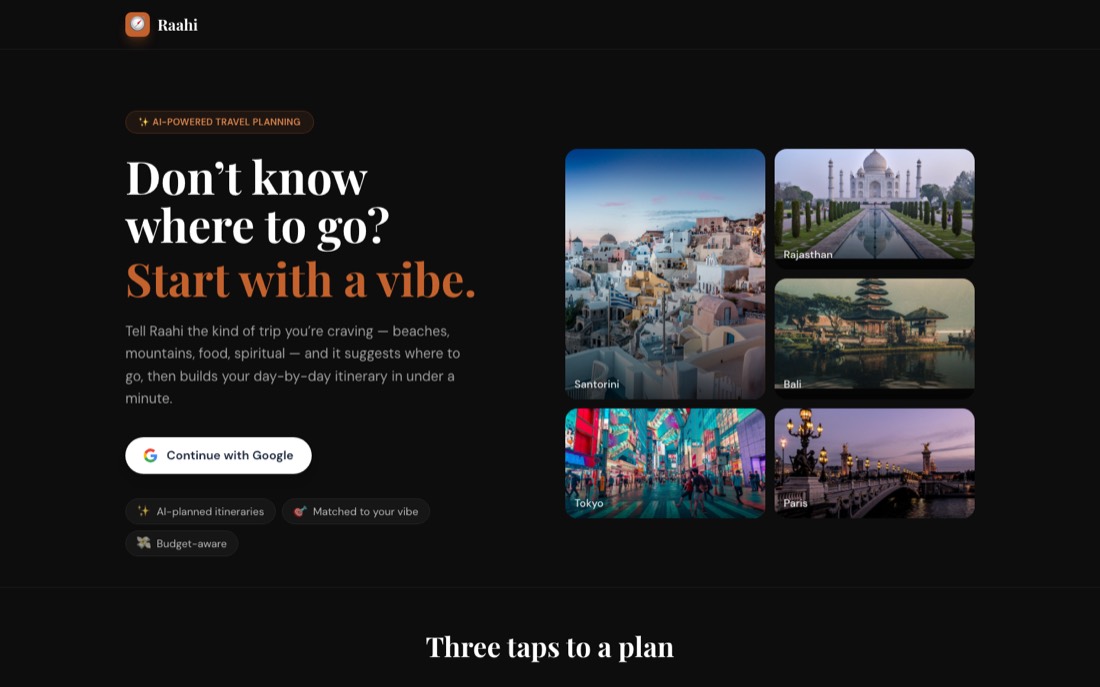
Pick a vibe — beaches, mountains, biking, spiritual — and Raahi matches destinations to your budget and who you're travelling with, including safety-first options for women travelling solo, then builds a day-by-day itinerary with hotels across budgets and live weather.
The model proposes; the application constrains. Budget arithmetic, date handling and hotel tiering are ordinary code — a language model asked to do sums inside a paragraph will get them subtly wrong, and nobody notices until someone books.
06 The platform underneath all of it
One box, fourteen applications
LiveSelf-hosted, self-operated — the part that isn't a side project
Everything above runs on a single VPS I administer — fourteen applications behind one nginx terminating TLS for every host, an OAuth proxy in front of the gated surfaces, PostgreSQL and SQLite, Let's Encrypt, a systemd unit per application, and CI from GitHub per repository. Some are proxied Node services, some are static bundles served straight off disk with no process at all; there is also a two-player Ludo game in there, because not everything needs a business case.
The deployment design came out of a real failure. The GitHub runner's SSH connection into the box timed out roughly half the time — a TCP connect timeout, upstream, not a key or firewall problem. The failure mode was the dangerous kind: the workflow went red, the push looked fine, and the box quietly stayed on the previous commit.
So I inverted it. Each application has a systemd timer that pulls every two minutes, guarded
by a flock so the timer and the CI job can't race, and by a build stamp written
only after a build that actually succeeded — because on a monolith, a failed build leaves the
repository on the new commit while the service still runs the old bundle, and a naive
"am I behind?" check sails straight past that.
A green build is not a healthy deploy. Verification checks the deployed commit and the application's own response, and accepts any real HTTP answer rather than demanding a 200 — insisting on 200 just produces false alarms on every redirect and every authenticated route.